California Department of Social Services
The California Department of Social Services is a state led, county administered child welfare system with 13,000 employees. They support 58 county child welfare departments to serve children and families effectively. CDSS has a workgroup dedicated to workforce issues and is interested in building their capacity to create a sustainable, quality child welfare workforce development framework. They will partner with select counties on an initiative to improve their use of data and workforce outcomes.

Developing a Dashboard
Recruiting and retaining qualified child welfare employees is a challenge for many agencies. California’s state-supervised and county-administered system is no different and it has direct consequences for children and families and workforce sustainability. Yet decision-makers have historically lacked a clear, shared picture of where hiring processes succeed, and where they break down.
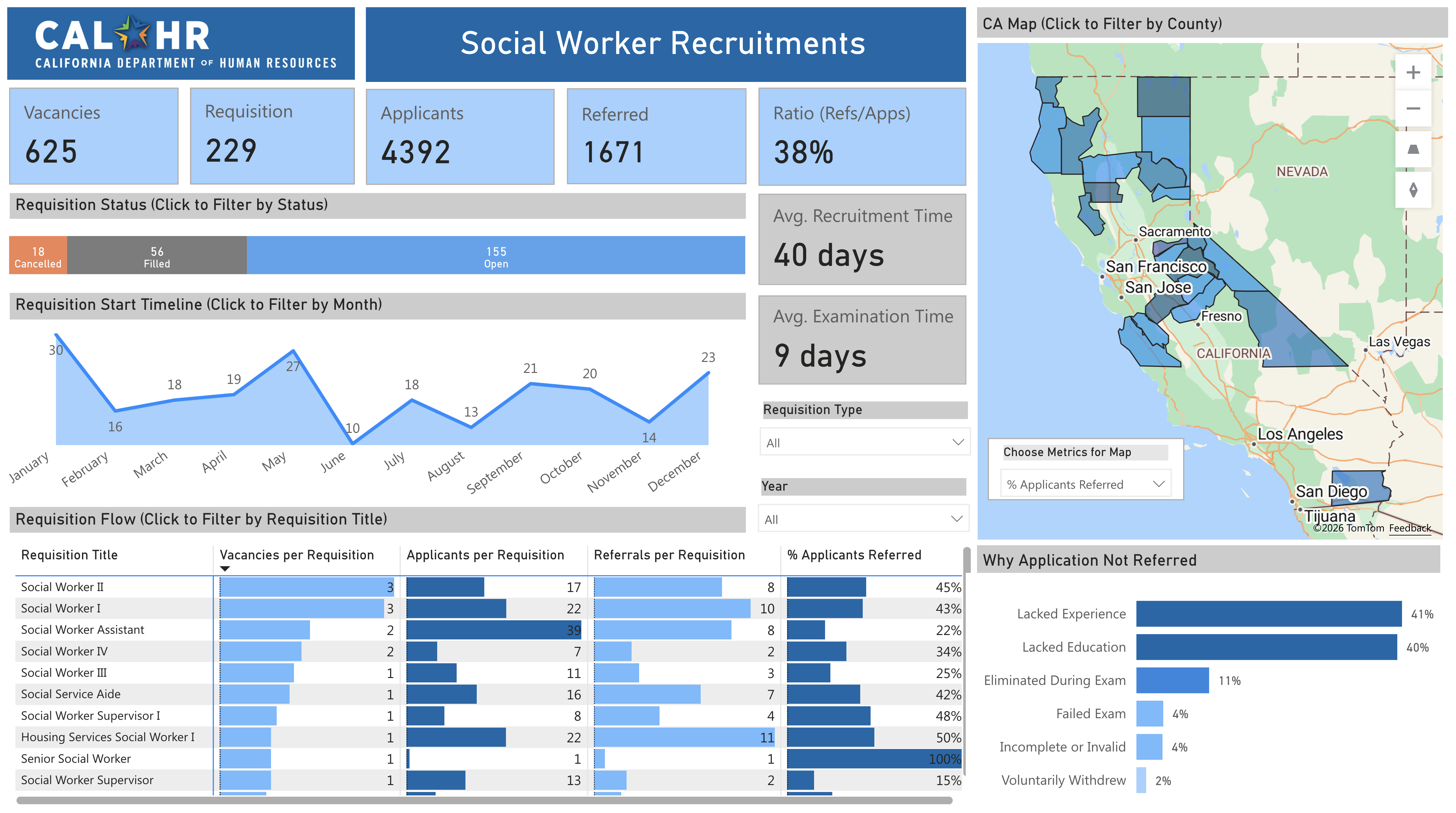
The California Department of Human Resources (CalHR) and the Quality Improvement Center for Workforce Analytics (QIC-WA) partnered to develop a Social Worker Recruitment & Hiring Dashboard to address a gap. The dashboard is an interactive tool that brings more transparency to CalHR’s role in recruiting and hiring county child welfare workers.
What the Dashboard Does
The dashboard consolidates recruitment and hiring data relevant to counties partnering with CalHR. It offers a comprehensive view of key steps in CalHR’s review of applications. This spans from vacancies through examinations, and referrals to counties. Rather than focusing on isolated counts, it emphasizes flow, timing, and attrition. It enables county leaders to know how long the CalHR review takes and see why candidates most often are not referred to as counties.
Key Insights
- Recruitment and examination timeline: It helps distinguish recruitment delays from examination delays.
- Reasons applicants are not referred: The dashboard shows that education and experience requirements are the primary barriers to applicants moving through CalHR’s review and on to consideration by partner counties.
- County-level metrics: This is accessible in the same space as metrics from all CalHR partnering counties. It is used to support interpretation in context.
All data are aggregated and privacy protected. This ensures the dashboard supports learning and planning rather than candidate-level scrutiny.
Why This Matters for Policy & Leadership
The dashboard reframes recruitment challenges as systemic recruitment and hiring process issues. It does not isolate county failures. By revealing statewide and county patterns, it helps leaders:
- Improve communication and transparency between CalHR and counties about the application process.
- Identify where upstream investments (education pipelines, training pathways, feeder classifications) are likely to have the greatest impact.
- Align state- and county-level strategies using a shared information.
In short, it replaces anecdotes with evidence and enables more targeted, defensible policy decisions.
Designed for Sustainability
The dashboard was developed by the QIC-WA in Power BI to ensure long-term sustainability. CalHR actively uses Power BI in other functions. The QIC-WA developed a comprehensive maintenance runbook documenting data requirements, calculations, and update procedures. This tool allows CalHR to regularly refresh and extend the dashboard. CalHR plans quarterly updates to balance timeliness with interpretability and to surface meaningful trends over time.
Looking Ahead
The Social Worker Recruiting & Hiring Dashboard creates new opportunities to pair data with targeted technical assistance and policy interventions for California counties. Ultimately, it enables routine reporting to support a more qualified and sustainable child welfare workforce.
Explore the Dashboard